
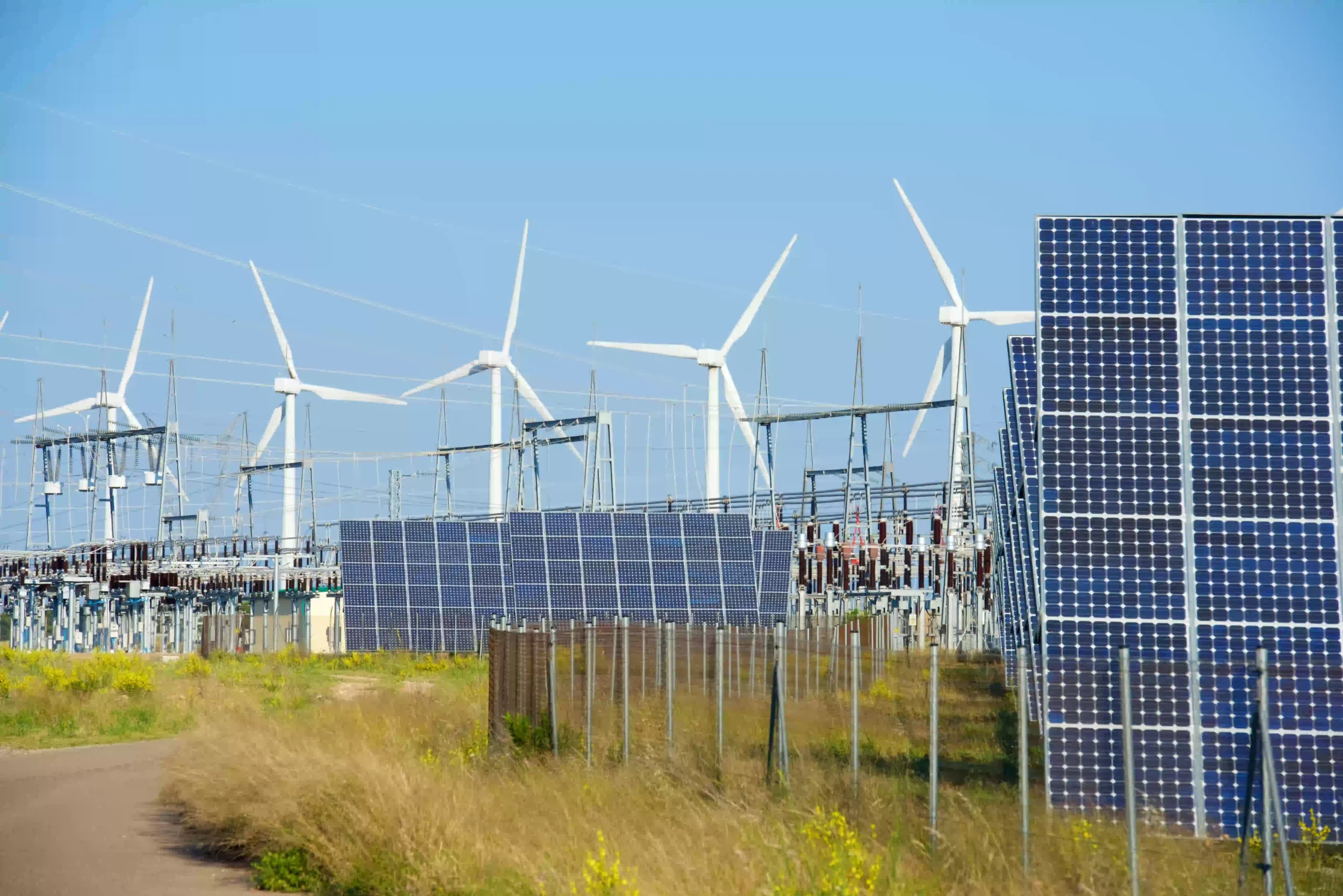
The seven main types of energy are kinetic, potential, thermal, chemical, electrical, radiant and nuclear energy. Every form of energy people use, from sunlight to a phone battery, fits one of these or converts between them. Seven is a teaching convention: the U.S. Energy Information Administration sorts energy into two categories, potential and kinetic, and many courses list six forms instead.
The 7 Types of Energy at a Glance
Potential energy is stored, and kinetic energy is in motion. Each of the seven types falls under one of those two categories.
| Type | What it is | Everyday example | Category |
|---|---|---|---|
| Kinetic | Energy of motion | Wind, a moving car | Kinetic |
| Potential | Stored energy from position or condition | Water behind a dam, a compressed spring | Potential |
| Thermal | Heat from moving atoms and molecules | Hot tea, geothermal heat | Kinetic |
| Chemical | Energy held in the bonds of atoms and molecules | Gasoline, food, batteries | Potential |
| Electrical | Energy carried by moving electrons | Lightning, household current | Kinetic |
| Radiant | Electromagnetic energy travelling in waves | Sunlight, radio waves, X-rays | Kinetic |
| Nuclear | Energy stored in an atom’s nucleus | Nuclear power reactors | Potential |
The categories above follow the EIA’s forms of energy page, which also lists gravitational, stored mechanical and sound energy. Those sit inside potential or kinetic energy rather than outside them.
What Is Energy?
Energy is the ability to do work, such as moving an object, heating a room or powering a phone. Scientists treat it as a measurable quantity that shows up in different forms, and the seven types above are the most common way to sort those forms.
The Scientific Definition of Energy
The EIA defines energy as the ability to do work. Work means a force moving something over a distance, which covers everything from a rolling ball to current flowing through a wire. In the United States, the British thermal unit (Btu), a measure of heat energy, is the common unit for comparing energy types, according to the EIA’s U.S. energy facts.
The Law of Conservation of Energy
Energy cannot be created or destroyed. It can only change from one form to another, a principle known as the law of conservation of energy, as explained in Penn State’s energy course notes. When energy seems to disappear, it has usually turned into a form that is harder to use, most often waste heat. This single rule is why understanding energy types matters: every machine, power plant and living cell is a converter between them.
The 7 Main Types of Energy Explained
Each type below has a plain definition, a real example and the way it connects to the others.
1. Kinetic Energy
Kinetic energy is the energy of motion. The EIA describes it as the motion of waves, electrons, atoms, molecules, substances and objects. The faster an object moves, the more kinetic energy it holds, and that energy is released as the object slows down. Wind is the standard example, which is why a wind turbine can turn moving air into usable power.
2. Potential Energy
Potential energy is stored energy, or the energy of position. A rock on a cliff, a stretched rubber band and water held behind a dam all store it. Water behind a hydropower dam has gravitational potential energy that becomes kinetic energy as it falls, then electrical energy as it spins turbines, as Penn State’s energy fundamentals lesson describes. The higher and heavier an object is, the more gravitational energy it stores.
3. Thermal Energy (Heat)
Thermal energy comes from the movement of atoms and molecules in a substance, and heat increases when those particles move faster, per the EIA. Geothermal energy is thermal energy stored in the earth. A warm cup of tea and the friction of bike brakes are everyday examples. Thermal energy is also where most conversions end up, because heat is the usual by-product of every other energy change.
4. Chemical Energy
Chemical energy is stored in the bonds between atoms and molecules. Batteries, biomass, petroleum, natural gas and coal are all examples, according to the EIA. Burning gasoline in an engine releases it as heat, and your body releases it from food through metabolism. Plants work in reverse: photosynthesis absorbs light and stores it as glucose, a process covered in North Dakota’s energy education materials.
5. Electrical Energy
Electrical energy is delivered by electrons, tiny charged particles that typically move through a wire. Lightning is the natural example. Electricity is usually a secondary energy source, meaning it is made from other sources such as coal, natural gas, sunlight or wind, as the EIA’s overview of energy sources explains. Because it can be converted into light, heat and motion, electricity is a flexible way to deliver energy.
6. Radiant Energy (Light)
Radiant energy is electromagnetic energy that travels in waves. It includes visible light, X-rays, gamma rays and radio waves, and sunshine is the most important source on Earth. NASA measures about 1,360 watts per square meter reaching the top of the atmosphere facing the Sun, which averages to roughly 340 watts per square meter across the whole planet. About 30 percent of incoming sunlight is reflected straight back to space, according to NASA’s SORCE mission page.
7. Nuclear Energy
Nuclear energy is stored in the nucleus of an atom, the energy that holds it together. Large amounts are released when nuclei are split apart (fission) or combined (fusion), per the EIA. Today’s power plants use fission. The World Nuclear Association reports that reactors worldwide generated a record 2,702 terawatt-hours in 2025, about 9 percent of the world’s electricity, from roughly 440 reactors in 31 countries.
How Energy Changes Form: Real Examples
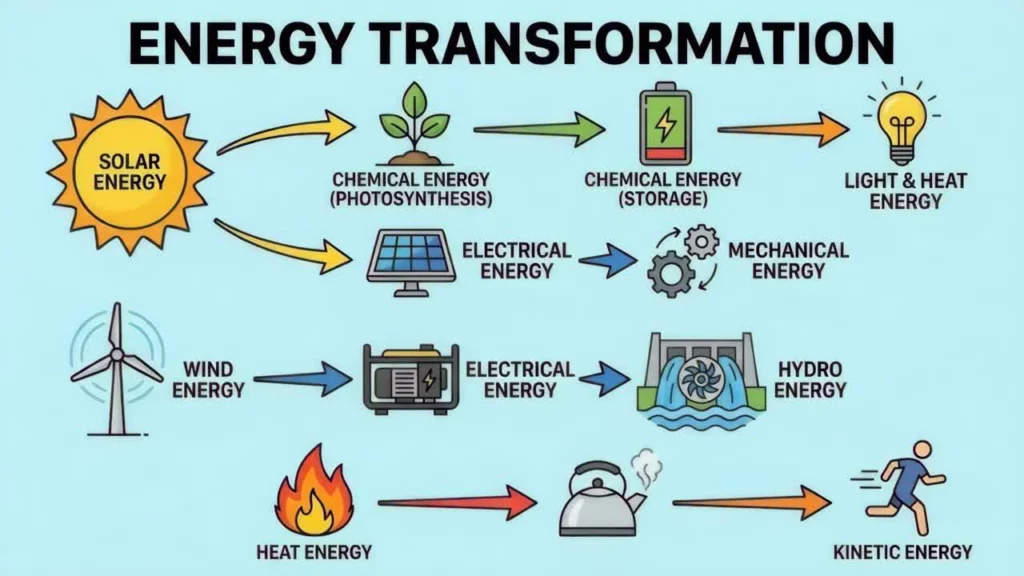
Energy conversion happens whenever something useful gets done, and most real systems chain several types together. The table shows six common chains.
| Process | Conversion chain | Source |
|---|---|---|
| Coal power plant | Chemical → thermal → kinetic (spinning turbine) → electrical | LibreTexts |
| Hydropower dam | Gravitational potential → kinetic → electrical | Penn State |
| Solar panel | Radiant → electrical | Penn State |
| Gasoline car engine | Chemical → thermal → mechanical, with much lost as waste heat | Penn State |
| Human body | Chemical (food) → mechanical, thermal and nerve electrical signals | Penn State |
| Photosynthesis | Radiant (light) → chemical | LibreTexts |
Two patterns show up in every row. First, thermal energy appears as a middle step or a by-product almost everywhere, which is why engines and power plants are never fully efficient. Second, nearly all energy on Earth traces back to the Sun, since most energy sources are stored energy that arrived as sunlight. Fossil fuels, food, wind and hydropower all began as radiant energy.
Energy Types vs. Energy Sources: What Powers the World in 2026
An energy type describes the form energy takes, such as chemical or radiant. An energy source is where that energy comes from, such as coal, sunlight or uranium. The two terms are often confused, so this guide keeps them apart.
Renewable and Nonrenewable Sources
The EIA sorts every energy source as renewable or nonrenewable. Renewable sources are naturally replenished, since the sun keeps shining, plants keep growing, wind keeps blowing and rivers keep flowing. Renewables were the main energy source for most of human history. Nonrenewable sources began replacing them in the United States in the early 1800s, and fossil fuels were the main source by the early 1900s.
Key Energy Numbers for 2025 and 2026
The figures below show which energy types are gaining ground in electricity generation, based on the latest published data as of November 2026.
| Measure | Figure | Source |
|---|---|---|
| Share of global electricity from renewables plus nuclear, 2025 | 42%, projected to reach 50% by 2030 | IEA Electricity 2026 |
| Growth in solar PV generation, 2025 | 620 TWh, up from 450 TWh in 2024 | IEA Electricity 2026 |
| Solar PV share of global generation | Reaches 10% in 2026, approaches 18% in 2030 | IEA Electricity 2026 |
| Coal share of global power generation | 34% in 2025, falling to 27% by 2030 | IEA Electricity 2026 |
| Global nuclear generation, 2025 | 2,702 TWh, a record, about 9% of world electricity | World Nuclear Association |
| U.S. renewable share of primary energy, 2025 | About 9% of production and of consumption, both records | EIA |
In terms of the seven types, the shift is toward radiant energy (solar) and nuclear energy being converted into electrical energy, and away from the chemical energy stored in coal. Nuclear’s share of world electricity is down from around 17 percent in the mid-1990s even though output is at a record, because total electricity demand has grown faster, according to the World Nuclear Association’s 2026 outlook.